
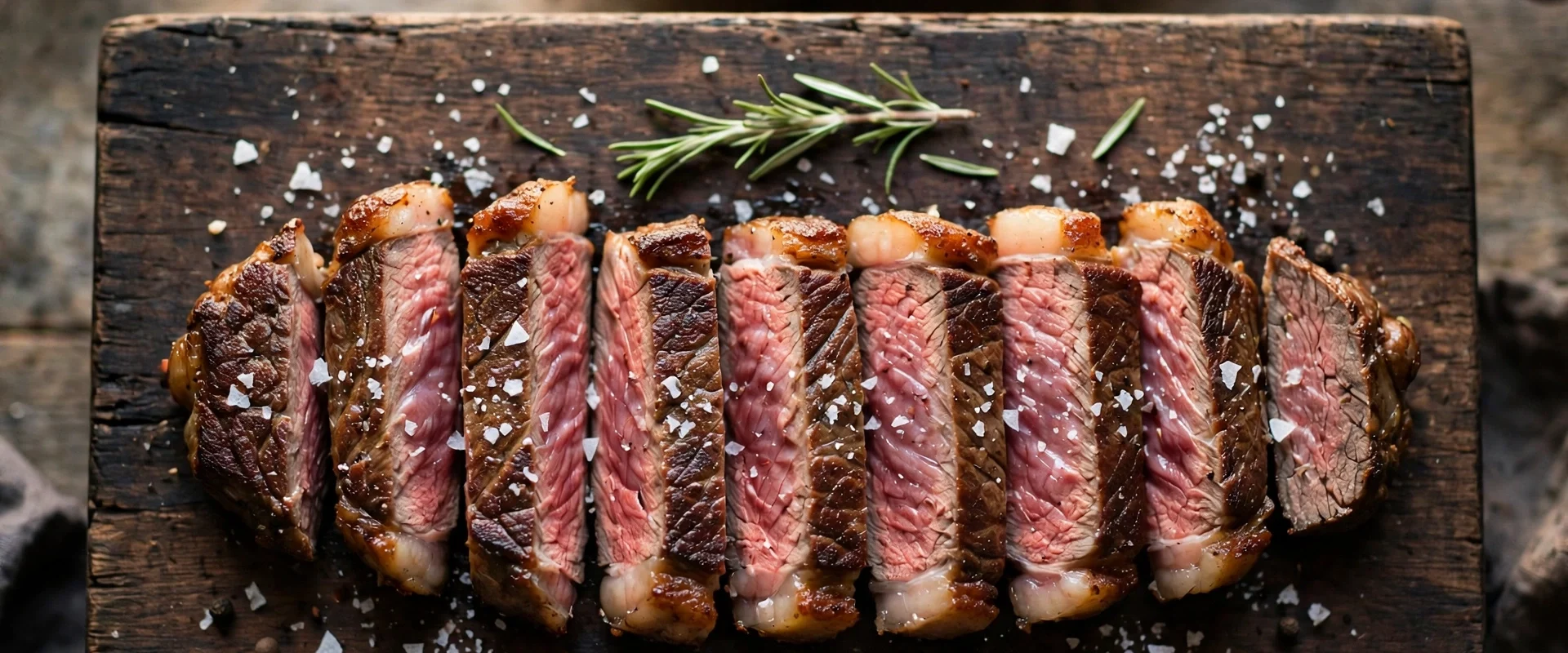
To cook a ribeye steak, pat it completely dry, season it generously with coarse salt and black pepper, and sear it in a ripping hot cast iron skillet for 3 to 4 minutes per side if the steak is 1 inch thick. Pull it off the heat at 125F for medium rare, baste it with garlic butter in the final minute, and rest it for 10 minutes before you slice it. Ribeye carries more marbling than any other everyday cut, so high heat, an accurate pull temperature, and a full rest are what turn that fat into a juicy, deeply crusted steak instead of a greasy one.
Key Takeaways
- Buy a ribeye that is 1 to 1.5 inches thick. Thinner steaks overcook before the crust forms.
- Pull the steak at 125F for medium rare. Carryover heat finishes it at 130 to 135F while it rests.
- Sear in cast iron or over direct grill heat, and do not move the steak until the crust releases on its own.
- Baste with garlic butter in the last minute for flavor without burning the garlic.
- Rest a full 10 minutes. Cutting early is the fastest way to lose the juices you worked for.
Why Ribeye Cooks Differently From Other Steaks
Ribeye comes from the rib section of the cow, a muscle that does very little work. That is why it stays tender, and it is also why the cut carries the heavy marbling that defines it. Threads of fat run through the whole steak, and a fatty cap called the spinalis sits along one edge. Many steak lovers, myself included, consider that cap the single best bite on the entire animal.
All that fat changes how you cook ribeye steak compared with a lean cut like sirloin. Fat renders as it heats, basting the meat from the inside, so ribeye forgives a small overshoot in a way filet never will. The trade off is that the same fat can turn the steak greasy if you cook it gently at low heat, and it can flare up badly on a grill. Ribeye wants aggressive heat and a confident hand. If you want the full comparison of how ribeye stacks up against filet, strip, and sirloin, my guide to the best cut of steak breaks down every trade off.
How to Choose the Right Ribeye
Start with thickness. A ribeye between 1 and 1.5 inches thick gives you enough time to build a proper crust before the center overcooks. Steaks under 1 inch reach medium before the outside browns, and steaks over 2 inches need the reverse sear method I cover below.
Look for marbling that spreads evenly through the whole steak in fine white threads, not one thick ribbon of fat down the middle. The color should be a bright, deep red. On grade, Prime carries the most marbling and Choice is the sweet spot for most home cooks. Select grade ribeye can taste lean and plain, which defeats the purpose of buying this cut. Bone in or boneless is your call. The bone insulates the meat next to it and looks spectacular on the plate, while boneless cooks a touch more evenly and slices more easily. In a skillet, I reach for boneless. On the grill for guests, I reach for bone in.
What You Need
For two people:
- 1 ribeye steak, 1 to 1.5 inches thick (about 16 to 20 ounces)
- 2 teaspoons coarse kosher salt
- 1 teaspoon freshly cracked black pepper
- 1 tablespoon high heat oil, such as avocado oil
- 2 tablespoons unsalted butter
- 2 garlic cloves, smashed
- 2 sprigs fresh thyme or rosemary
You also need a cast iron skillet or a grill, tongs, and an instant read thermometer. Prep takes 10 minutes, plus 30 to 45 minutes for the steak to lose its fridge chill. Cooking takes 10 to 14 minutes, and resting takes 10 minutes.
How to Cook Ribeye Steak in a Skillet: Step by Step
Step 1: Temper the Steak and Dry the Surface
Take the ribeye out of the fridge 30 to 45 minutes before cooking. A steak that starts closer to room temperature cooks more evenly from edge to center. Right before it hits the pan, pat every surface dry with paper towels. Moisture is the enemy of crust. A wet steak steams, and steamed beef turns grey instead of brown.
Step 2: Season Generously, or Dry Brine Ahead
Season both sides and the edges with the salt and pepper, pressing the seasoning in with your palm. If you have time, salt the steak the night before and leave it uncovered on a rack in the fridge. That dry brine seasons the meat deeply and dries the surface even further, and in my testing it produces the best crust of any method I have tried at home.
Step 3: Sear Hard and Do Not Move It
Heat the cast iron skillet over high heat until it just begins to smoke. Add the oil, swirl it, and lay the steak away from you. Press it down gently once so the whole surface makes contact, then leave it alone. The steak will stick at first and release on its own when the crust is ready. Sear 3 to 4 minutes on the first side for a 1 inch steak, then flip and sear 3 minutes on the second side. Render the fat cap by holding the steak on its edge with tongs for 30 to 45 seconds at the end.
Step 4: Baste With Garlic Butter
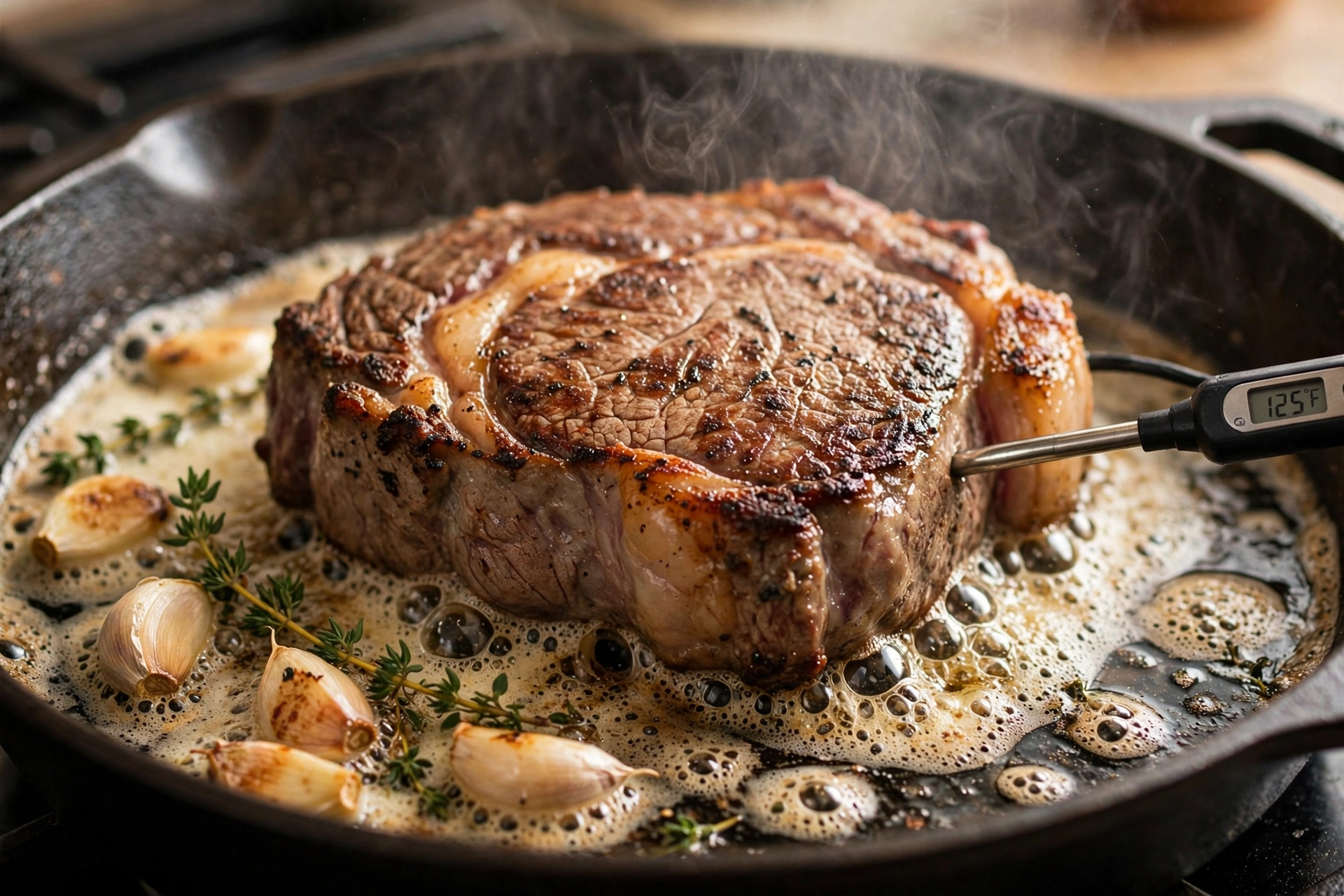
Drop the heat to medium. Add the butter, garlic, and thyme to the pan. When the butter foams, tilt the skillet and spoon the hot butter over the steak again and again for about 1 minute. This is where the steak picks up its steakhouse flavor, and doing it at the end keeps the garlic sweet instead of burnt and bitter.
Step 5: Check the Temperature and Pull Early
Insert the thermometer through the side of the steak into the center, away from fat pockets and bone. Pull the steak at 125F for medium rare, 120F for rare, or 135F for medium. The temperature keeps climbing 5 to 10 degrees while the steak rests, so the number you pull at is never the number you eat at. My full steak doneness guide explains pull temperatures and carryover cooking for every level.
How to Cook Ribeye Steak on the Grill
Grilling ribeye follows the same rules with one extra problem to manage: dripping fat and flare ups. Set up two zones, one ripping hot side and one cooler side. Oil the grates, then sear the steak over direct heat for 3 to 4 minutes per side with the lid open so you can watch for flames. When fat flares, move the steak to the cool zone for a few seconds instead of letting it sit in the fire and soot up. For steaks thicker than 1.5 inches, finish them on the cool side with the lid closed until the thermometer reads your pull temperature. Rest and slice exactly as you would a skillet steak.
Thick Ribeye: The Reverse Sear Oven Method
For a ribeye of 1.5 inches or more, reverse searing gives you the most even result. Season the steak, set it on a wire rack over a sheet pan, and bake it at 250F until the center reaches 110F, which takes 30 to 45 minutes depending on thickness. Rest it for 10 minutes while you heat a cast iron skillet until it smokes, then sear 60 to 90 seconds per side and baste with butter. The center ends up the same color from edge to edge, with no grey band. My complete guide to cooking steak in the oven walks through both oven methods in detail.
Ribeye Cooking Times and Temperatures
Use this chart as your starting point and confirm everything with the thermometer. Times assume a steak that lost its fridge chill before cooking.
| Thickness | Skillet or Grill, per Side | Best Method |
|---|---|---|
| 1 inch | 3 to 4 minutes | Direct sear |
| 1.25 inches | 4 to 5 minutes | Direct sear, brief oven finish if needed |
| 1.5 inches | 4 to 5 minutes, plus 4 to 6 minutes indirect | Two zone grill or reverse sear |
| 2 inches | Sear 60 to 90 seconds per side after the oven stage | Reverse sear |
Pull temperatures by doneness:
- Rare: pull at 115 to 120F, rest to 120 to 125F
- Medium rare: pull at 125F, rest to 130 to 135F
- Medium: pull at 135F, rest to 140 to 145F
I cook almost every ribeye to medium rare, and the dedicated medium rare steak temperature page explains why that range suits this cut so well. For food safety reference, the FoodSafety.gov chart of safe minimum internal temperatures lists 145F with a 3 minute rest as the safe minimum for whole beef cuts.
Resting, Slicing, and Serving
Move the steak to a warm plate or a wire rack and rest it for 10 minutes, loosely tented with foil. Resting lets the juices settle back through the meat. Slice a boneless ribeye across the grain into strips about half an inch thick. Serve a bone in ribeye whole and let people carve at the table.
Ribeye is rich, so it pairs best with sides that bring acid or crunch. My tested roundup of good sides for steak matches sides to cuts, and ribeye does especially well with a sharp arugula salad or roasted Brussels sprouts. If you end up with leftovers, reheat them gently the next day using my guide to reheating steak instead of blasting them in the microwave.
The Ribeye Family: Bone In, Cowboy, and More
Once the classic ribeye is second nature, the rest of the family opens up. A cowboy cut steak is a thick bone in ribeye with a short frenched bone, built for the grill. A long bone tomahawk style ribeye turns the same idea into a centerpiece. For pure crust, my tallow fried ribeye method fries the steak in rendered beef fat. And when a ribeye is past its prime for serving whole, slice it thin for a ribeye Philly cheesesteak. Every one of those cooks best when the fundamentals on this page are already in your hands.
Common Ribeye Mistakes
Cooking It Straight From the Fridge
A cold center and a hot pan give you a burnt crust over a raw middle. The 30 to 45 minute temper on the counter fixes it.
Pulling at the Final Temperature
If the thermometer reads 135F in the pan, the steak will eat like medium after its rest, not medium rare. Pull 5 to 10 degrees early, every time.
Skipping the Rest
Cut into a ribeye the moment it leaves the pan and the juices run onto the board. Ten minutes of patience keeps them in the meat.
Letting Flare Ups Soot the Crust
On the grill, ribeye fat will catch fire. Move the steak to the cool zone during a flare instead of serving a crust that tastes like a candle.
FAQ: How to Cook Ribeye Steak
What is the best way to cook a ribeye steak?
A cast iron skillet gives most home cooks the best ribeye: a deep crust, full contact with the pan, and a garlic butter baste at the end. The grill wins for bone in steaks and smoky flavor, and the reverse sear wins for anything 1.5 inches or thicker.
How long do you cook a ribeye steak per side?
For a 1 inch ribeye over high heat, cook 3 to 4 minutes per side for medium rare. A 1.5 inch steak needs 4 to 5 minutes per side plus a few minutes of indirect heat, or the reverse sear method.
What temperature should a ribeye steak be cooked to?
Pull a ribeye at 125F for medium rare and let it rest to 130 to 135F. Ribeye fat renders best in that range. Past 145F the steak firms up and starts to lose the juiciness that makes the cut worth buying.
Is bone in or boneless ribeye better?
Neither is clearly better. Bone in steaks insulate the meat near the bone and present beautifully. Boneless steaks cook a little more evenly and are easier to slice and serve. Buy on thickness and marbling first.
Why did my ribeye turn out greasy?
Greasiness usually means the heat was too low or the steak was crowded in a pan that was not hot enough. Ribeye fat needs high heat to render and crisp. Sear it hot, rest it on a rack instead of in its own drippings, and the texture turns rich instead of greasy.
Can you cook a ribeye steak from frozen?
Yes, with lower heat and more time, and the result is better than most people expect. My tested guide on how to cook steak from frozen covers the exact method.