
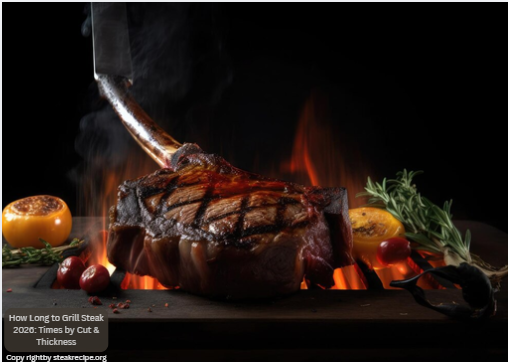
Most articles about how long to grill steak give you one generic answer”4 to 5 minutes per side and never explain that this number is wrong for most cuts, most thicknesses, and most grill setups. After researching grilling methods across dozens of cuts and cross-referencing USDA internal temperature guidelines, this guide gives you exact times for every scenario. No vague ranges. No leaving you to search again.
Also Read: Steak Doneness Calculator — Get Your Exact Pull Temperature
What Does “How Long to Grill Steak” Actually Mean?
It means the total active time on the grill — from the moment the steak hits the grate to the moment you pull it off. It does not mean time to final doneness, because your steak keeps cooking after it leaves the grill.
Internal temperature rises 3°F to 5°F during the rest period. This is called carryover cooking, and it is the single most overlooked variable in every generic grilling guide. If you are targeting 135°F for medium-rare, pull the steak at 130°F — not 135°F. Miss this and a medium-rare steak becomes medium every single time
Why Generic Grilling Times Are Outdated in 2026
The “4 minutes per side” rule was written for a specific scenario: a 1-inch steak, a preheated gas grill at 450°F, started at room temperature. Change any one of those variables and the number breaks down.
- A cold steak straight from the fridge adds 1 to 2 minutes per side
- A grill running at 400°F instead of 500°F adds another minute per side
- A 1.5-inch steak needs a completely different method than a 1-inch steak
What still works in 2026 is simple: use thickness, grill temperature, and a meat thermometer together — not time alone. Time is a guide. Temperature is the decision point.
Also Read: Checking Steak Doneness — Every Method Explained
Master Grilling Time Chart (1-Inch Steak, 450°F–500°F Direct Heat)
This is the most accurate baseline for a standard supermarket-thickness steak over high direct heat. All internal temperatures align with USDA Food Safety guidelines.
| Doneness | Time Per Side | Pull-Off Temp | Final Resting Temp |
|---|---|---|---|
| Rare | 2–3 min | 120°F | 125°F |
| Medium-Rare | 3–4 min | 130°F | 135°F |
| Medium | 4–5 min | 140°F | 145°F |
| Medium-Well | 5–6 min | 150°F | 155°F |
| Well-Done | 6–7 min | 160°F | 165°F+ |
Always verify with a meat thermometer. Times are starting points. Thermometers are facts.
Grilling Times by Steak Thickness
This is what most competitor articles skip entirely. Thickness changes the entire method — not just the time.
1-inch thick steak (standard supermarket cut)
- Cook over direct high heat the entire time
- Rare: 2–3 min per side
- Medium-Rare: 3–4 min per side
- Medium: 4–5 min per side
1.5-inch thick steak (restaurant-style portion)
- Sear 4–5 min per side over direct heat
- Move to indirect heat for 3–5 minutes to finish the center
- Do not try to finish this cut over direct heat — the exterior burns before the center reaches temperature
2-inch and above (tomahawk, cowboy cut, thick ribeye)
- Use the two-zone method or reverse sear — explained in detail below
- Total time: 30–45 minutes
- Pull off temp: 5°F below your target doneness
Also Read: Reverse Sear Method — Why It Beats Direct Heat on Thick Cuts
Grilling Times by Cut
Every cut has a different fat content, grain structure, and ideal doneness target. Here is what matters per cut when grilling:
| Cut | Ideal Doneness | Time Per Side (1 inch) | Key Note |
|---|---|---|---|
| Ribeye | Medium-Rare | 3–4 min | High fat — watch for flare-ups |
| New York Strip | Medium-Rare to Medium | 4–5 min | Leaner, more forgiving |
| Filet Mignon | Rare to Medium-Rare | 3–4 min | Lean — overcooks in seconds |
| T-Bone / Porterhouse | Medium-Rare | 4–5 min | Two muscles — cook to strip side temp |
| Flank Steak | Medium | 4–5 min | Thin — slice against grain after |
| Skirt Steak | Medium | 3–4 min | Very thin — 2 min per side on ripping hot grill |
| Sirloin | Medium | 4–5 min | Lean — benefits from brief marinade |
| Hanger Steak | Medium-Rare | 3–4 min | Loses texture badly if overcooked |
What Grilling Methods Still Work in 2026
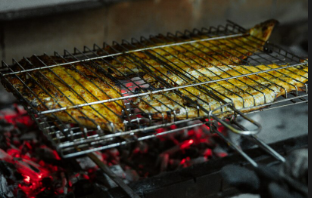
Two-Zone Method
This is the correct approach for anything 1.5 inches or thicker. Set up your grill with one side on high heat and the other side off or very low.
- Sear over direct heat: 2–3 minutes per side to build the crust
- Move to indirect heat: finish until internal temp hits your pull-off target
- Works on both gas and charcoal grills
During research, this method consistently produced better results than single-zone cooking on thick cuts — the Serious Eats Food Lab has documented this extensively and it remains the gold standard.
Reverse Sear on the Grill
For steaks 2 inches and above, reverse sear produces the most evenly cooked interior. Here is the timing breakdown:
- Start on indirect heat at 225°F–250°F until internal temp reaches 110°F–115°F
- Rest 10 minutes while grill rips up to 500°F+
- Sear 1–2 minutes per side
- Rest 5 minutes before slicing
Total time: 35–50 minutes. Longer than direct heat — but produces edge-to-edge color that no other method matches on thick cuts.
What No Longer Works Reliably
The “poke test” — pressing the steak and comparing firmness to your palm. Unreliable across different cuts and fat levels. It can give a rough signal but will fail you on lean cuts like filet and skirt steak.
Timing by color alone — the exterior of a steak browns well before the interior reaches temperature. A steak can look done and be raw in the center.
The “4 minutes per side” universal rule — this ignores grill temperature, starting meat temperature, and cut thickness. It is accurate only in a very narrow set of conditions.
Pressing down on the steak — this squeezes out moisture and collapses the interior structure. Never press.
Is It Safe to Grill at These Temperatures?
Yes — when you hit the correct internal temperatures. The USDA recommends a minimum internal temperature of 145°F for whole muscle beef steaks, followed by a 3-minute rest.
Important distinction: 145°F is the food safety minimum, not the flavor target. Medium-rare at 135°F is considered safe by most culinary professionals for whole muscle cuts because surface pathogens are destroyed during searing. Ground beef is a different category and must always reach 160°F.
Never let raw steak sit at room temperature for more than 30 minutes before grilling this is a food safety limit, not just a prep tip.
Show Image
Visual temperature reference chart showing safe internal temps by doneness level
Also Read: Common Steak Cooking Mistakes — And How to Fix Them
Gas vs Charcoal vs Pellet Grill — Time Comparison
The grill type affects both time and flavor. Here is how they compare for a 1-inch medium-rare steak:
| Grill Type | Preheat Time | Time Per Side | Flavor Profile | Best For |
|---|---|---|---|---|
| Gas Grill | 10–15 min | 3–4 min | Clean, neutral | Consistent results, everyday cooking |
| Charcoal Grill | 20–30 min | 3–4 min | Smoky, complex | Best flavor on thin to mid cuts |
| Pellet Grill | 15–20 min | 4–5 min | Mild smoke | Thick cuts, reverse sear |
| Cast Iron on Grill | 10 min | 2–3 min | Deep crust | Restaurant-style sear |
Charcoal runs hotter with less control. Gas is more consistent. Pellet grills run slightly cooler by default — add 1 minute per side compared to gas at the same dial setting.
How Long to Rest Steak After Grilling
Resting is not optional. It is the final stage of the cook.
- 1-inch steak: Rest 5 minutes minimum
- 1.5-inch steak: Rest 7 minutes
- 2-inch or thicker: Rest 8–10 minutes
Rest on a wire rack or cutting board never a plate. A plate traps steam underneath and softens the crust. Do not tent tightly with foil it steams the exterior. A loose tent in a cold kitchen is acceptable.
Also Read: Resting & Slicing Techniques — The Step Most Home Cooks Skip
Frequently Asked Questions
How long do you grill a 1-inch steak for medium-rare?
Grill 3 to 4 minutes per side over direct high heat at 450°F–500°F. Pull the steak at 130°F internal temperature and rest for 5 minutes. It will reach 135°F during rest the correct final temperature for medium-rare.
How long do you grill a steak at 400°F?
At 400°F, add approximately 1 minute per side to the standard times. A 1-inch steak targeting medium-rare needs 4 to 5 minutes per side. Always confirm with a thermometer grill thermometers are often inaccurate; use a probe at grate level.
How long to grill a thick steak (2 inches or more)?
Plan 35 to 50 minutes total using the reverse sear or two-zone method. Sear 2 to 3 minutes per side over direct heat, then finish on indirect heat to your pull-off temperature. Rest 8 to 10 minutes before slicing.
Should I flip my steak more than once?
For thick cuts over 1.5 inches, flipping every 2 minutes produces a more even internal cook and reduces the grey overcooked band. For cuts under 1 inch, a single flip is sufficient.
How do I know when my steak is done without a thermometer?
The poke test gives a rough estimate but is unreliable across different cuts. An instant-read thermometer like the ThermoWorks Thermapen gives an accurate reading in 2 seconds and eliminates all guesswork. For a data-driven approach, use the Steak Doneness Calculator to find your exact pull temperature by thickness.
Does steak type change how long to grill it?
Yes. Lean cuts like filet mignon and skirt steak cook faster and overcook more easily than fatty cuts like ribeye. Refer to the cut-by-cut table above for accurate times per cut.
Final Thoughts
How long to grill steak is never one number. It depends on thickness, cut, grill temperature, and your doneness target. The times in this guide are accurate starting points but a meat thermometer is the only tool that gives you certainty every single time. The two things most grilling articles consistently get wrong: they give times without specifying grill temperature, and they ignore carryover cooking. Account for both and your steak will hit the right doneness consistently regardless of the cut or grill you’re using.
Pull early. Rest fully. Slice against the grain.