Most steak cooking charts online list cook times per side 4 minutes for medium-rare without mentioning that this only works for a steak of one specific thickness, on one specific heat source. Follow that chart with a thinner or thicker cut, and you’ll miss your target every time. A reliable steak cooking chart is built around internal temperature, not minutes on the clock. This guide breaks down the actual temperatures that matter, where time-based charts fall apart, and how to get consistent results regardless of cut or thickness.
What Is a Steak Cooking Chart?
A steak cooking chart is a reference table that maps doneness levels — rare, medium-rare, medium, and so on — to either cook time or internal temperature.
The two types behave very differently:
- Time-based charts estimate minutes per side based on an assumed thickness and heat level
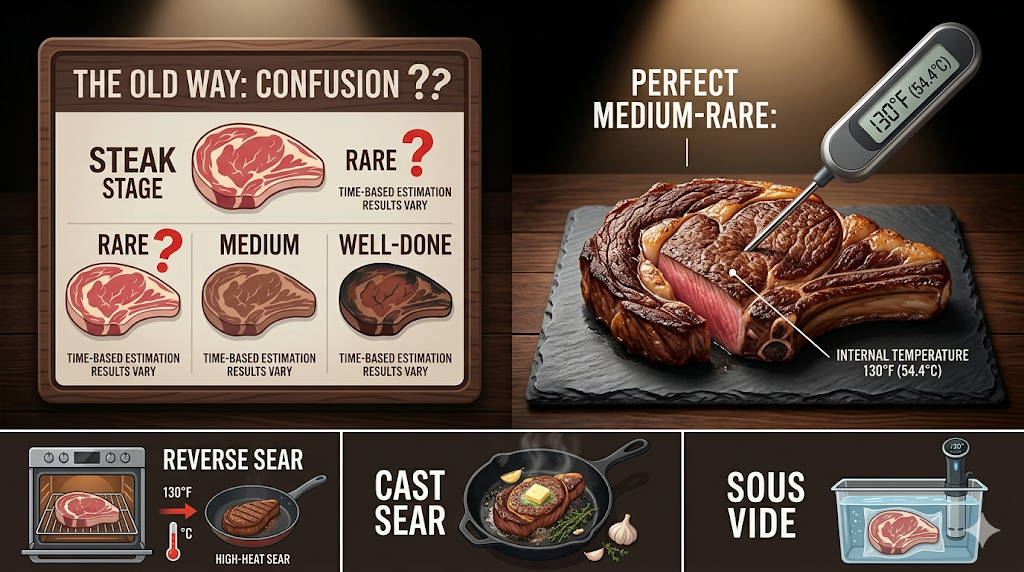
- Temperature-based charts list the internal temperature that defines each doneness level, regardless of cut, thickness, or cooking method
Temperature-based charts are far more reliable because they describe the actual physical state of the meat, not a rough guess based on assumptions that may not match your situation.
Why Time-Based Charts Became the Default
Cook-time charts are everywhere because they’re simple no thermometer required, just a clock. For a beginner who’s never used a meat thermometer, that simplicity feels approachable.
The problem is that cook time depends on far more variables than most charts account for: steak thickness, starting temperature (fridge-cold vs. room temperature), pan or grill heat, and even how much the steak has rested beforehand. Two steaks that are “the same cut” can need very different cook times if one is an inch thick and the other is an inch and a half.
This is why a steak that “looked perfect” by the clock can still come out under or overcooked — the chart wasn’t wrong about doneness temperatures, it was wrong to substitute time for temperature in the first place.
What Still Works Reliably in 2026
A few fundamentals around steak doneness haven’t changed and remain accurate:
- Internal temperature targets are stable. Rare, medium-rare, medium, medium-well, and well-done correspond to specific, well-established temperature ranges.
- Carryover cooking is real. A steak’s internal temperature continues to rise 3–5°F after it’s removed from heat, which is why pulling it slightly before your target temperature still gets you there.
- Resting time still matters. Letting a steak rest for 5–10 minutes after cooking allows juices to redistribute, regardless of which cut or doneness level you’re aiming for.
- A reliable thermometer remains the single best tool for hitting a target doneness consistently, more so than any visual or touch-based method.
Where Steak Cooking Charts Often Get It Wrong
A few patterns are worth calling out, because they show up across a lot of cooking content:
- Listing only cook time, with no temperature reference at all. Without a temperature anchor, the chart can’t account for thickness or heat variation.
- Treating all doneness ranges as single numbers instead of ranges. “Medium-rare is 130°F” is more useful when shown as a 130–135°F range, since a few degrees either way still falls within that doneness level.
- Ignoring carryover cooking entirely. Charts that tell you to cook to your exact target temperature often result in slightly overcooked steak once carryover is factored in.
- Not accounting for bone-in cuts. Bone-in steaks can cook differently near the bone than time-only charts suggest, since bone conducts heat differently than muscle.
Steak Doneness Chart: Internal Temperatures
This is the core reference internal temperature before removing from heat, accounting for roughly 3–5°F of carryover rise during rest:
| Doneness | Pull Temp (Remove from Heat) | Final Resting Temp | Center Color |
|---|---|---|---|
| Rare | 115–120°F | 120–125°F | Bright red, cool center |
| Medium-Rare | 125–130°F | 130–135°F | Warm red center |
| Medium | 135–140°F | 140–145°F | Pink center |
| Medium-Well | 145–150°F | 150–155°F | Slightly pink |
| Well-Done | 155°F+ | 160°F+ | No pink, firm |
These ranges apply across most whole-muscle cuts ribeye, strip, filet, sirloin though very thin cuts (under ¾ inch) cook through faster and benefit from higher, quicker heat to avoid overshooting.
Is Cooking Steak to These Temperatures Safe?
For whole-muscle steaks like ribeye, strip, and filet, the USDA recommends a minimum internal temperature of 145°F with a 3-minute rest, which lands in the medium range on the chart above. Rare and medium-rare steaks fall below this threshold, which is a personal risk tolerance decision — generally considered lower-risk for whole-muscle cuts than for ground beef, since bacteria primarily live on the surface of an intact muscle rather than throughout it.
Ground beef is a different story entirely: it requires a higher internal temperature (160°F) because grinding can spread bacteria from the surface throughout the meat. A steak cooking chart for ground beef patties should not be treated the same as one for whole-muscle steaks.
Better Alternatives to a Generic Cooking Chart
A single chart can’t account for every variable, so here’s how to adjust based on your actual setup:
| Method | Best For | Key Adjustment |
|---|---|---|
| Instant-read thermometer | Any cut, any doneness | Most accurate — pull at target temp, account for carryover |
| Reverse sear | Thick cuts (1.5″+) | Cook low and slow first, sear last — chart times don’t apply |
| Cast iron pan-sear | Thinner cuts, high heat | Shorter cook time than grill charts suggest |
| Sous vide | Precision doneness | Bypasses the chart entirely — water bath sets the exact internal temp |
| Touch test (no thermometer) | Backup only | Least reliable — useful only as a rough cross-check |
Is It Legal to Cook Steak to Any Doneness You Want?
Yes at home, there’s no legal restriction on how you cook your own food, including rare or blue-rare steak. The USDA’s 145°F guidance is a safety recommendation, not a legal requirement for home cooking. Restaurants face different rules: many jurisdictions require menus to carry a consumer advisory if they serve undercooked meat, but this is a disclosure requirement, not a ban on serving rare steak.
Should You Still Rely on a Cooking Chart?
Yes, but the right kind. A temperature-based chart paired with an instant-read thermometer remains the most reliable way to hit consistent doneness, regardless of cut, thickness, or cooking method. A time-only chart can work as a rough starting estimate, but it shouldn’t be your final check the thermometer should always have the last word.
Also Read
FAQs
What temperature is medium-rare steak?
Medium-rare is typically 130–135°F at final resting temperature, pulled from heat around 125–130°F to account for carryover cooking.
How long should I cook steak per side?
There’s no universal answer it depends on thickness and heat level. A temperature-based chart is far more reliable than a fixed cook-time chart.
Do I need a meat thermometer to follow a steak cooking chart accurately?
Yes, for reliable results. Touch tests and visual cues are useful as backups, but a thermometer is the only way to confirm internal temperature precisely.
Why does my steak keep coming out overcooked even when I follow a chart?
This is usually due to carryover cooking — the steak continues rising in temperature after removal from heat, so pulling at your exact target often overshoots.
Is it safe to eat steak rare?
For whole-muscle cuts, many people consider it lower risk than ground beef, though the USDA’s official safety recommendation is 145°F minimum. Personal risk tolerance varies.
Final Thoughts
A steak cooking chart is only as useful as the data it’s built on. Time-based charts offer a rough starting point, but a temperature-based chart paired with a reliable thermometer is what actually gets you consistent, repeatable results regardless of which cut you’re working with. Once you know the internal temperature targets and account for carryover cooking, hitting your preferred doneness stops being guesswork.